
Introduction
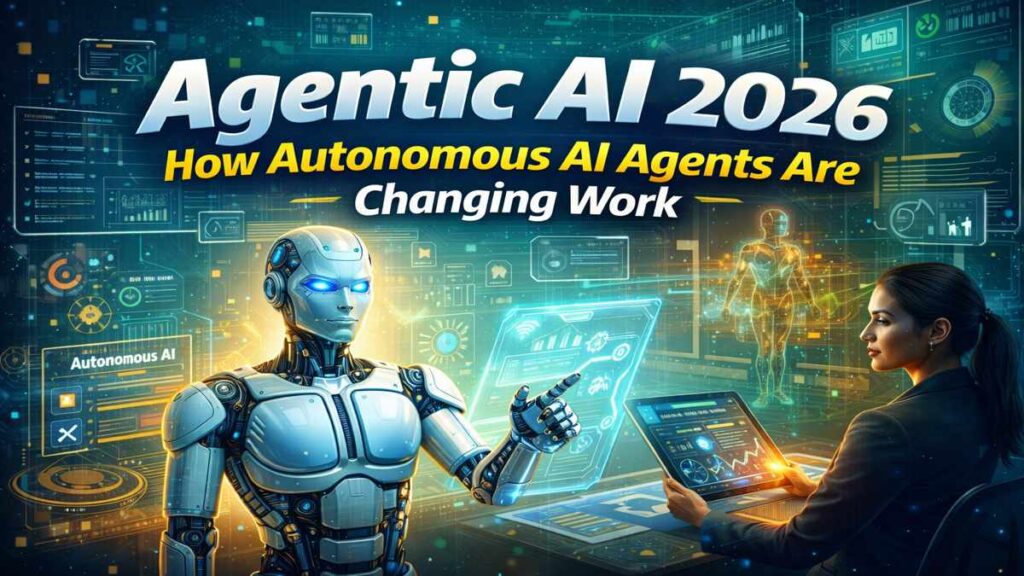
Agentic AI is no longer a futuristic concept or a research experiment. By 2026, it is becoming one of the most disruptive forces in artificial intelligence. Unlike traditional AI systems that wait for human instructions, Agentic AI systems can plan, decide, and act independently to achieve goals.
This shift marks a major transition:
- From AI that assists
- To AI that executes
Agentic AI is already transforming businesses, smart homes, software development, healthcare workflows, and digital productivity. Understanding this technology early can offer a strong competitive advantage in the coming years.
What Is Agentic AI?
Agentic AI refers to autonomous AI agents that can:
- Understand goals
- Break them into tasks
- Decide the best actions
- Use tools or software
- Learn from outcomes
- Adjust future behavior
Unlike chatbots or single-task AI models, Agentic AI systems operate as decision-making entities.
Simple Example
Instead of asking:
“Schedule a meeting”
You tell an agent:
“Prepare a client review for next week”
The AI agent may:
- Analyze emails
- Check calendars
- Book a meeting
- Create a summary
- Notify participants
- Follow up automatically
All without repeated prompts.
Why Agentic AI Is Exploding in 2026
Several technological shifts have made Agentic AI practical and scalable:
1. Advanced Large Language Models
Modern LLMs can reason, plan, and adapt across multiple steps.
2. Tool-Using AI
Agents can now interact with:
- APIs
- Databases
- Browsers
- CRMs
- Cloud platforms
3. Memory & Context Persistence
Agents remember past actions, preferences, and outcomes.
4. Falling Compute Costs
Cloud optimization and edge AI make long-running agents affordable.
Agentic AI vs Traditional AI
| Feature | Traditional AI | Agentic AI |
|---|---|---|
| User Control | Fully manual | Goal-based |
| Decision Making | Limited | Autonomous |
| Task Scope | Single task | Multi-step |
| Learning | Static | Continuous |
| Adaptability | Low | High |
Traditional AI responds.
Agentic AI acts.
Core Components of Agentic AI Systems
1. Goal Interpretation
Agents understand high-level human intent instead of rigid commands.
2. Planning Engine
They break goals into logical sub-tasks and execution paths.
3. Tool Execution
Agents choose and use tools automatically (APIs, apps, scripts).
4. Memory Layer
Short-term and long-term memory enables improvement over time.
5. Feedback & Self-Correction
Agents evaluate outcomes and optimize future actions.
Agentic AI in Business (2026 Use Cases)
🔹 Enterprise Automation
Agentic AI can:
- Handle invoice processing
- Manage HR onboarding
- Monitor compliance
- Optimize cloud spending
This reduces operational cost and human workload.
🔹 Sales & Marketing
AI agents can:
- Qualify leads
- Send personalized outreach
- Track customer responses
- Update CRM systems
Sales teams shift from execution to strategy.
🔹 Software Development
Coding agents:
- Write boilerplate code
- Fix bugs
- Run tests
- Deploy updates
Developers become supervisors instead of manual executors.
Agentic AI in Smart Homes
Future smart homes won’t just react — they will anticipate.
Agentic AI can:
- Adjust temperature based on habits
- Manage energy usage
- Detect unusual behavior
- Schedule maintenance
Homes become self-optimizing systems.
Agentic AI in Healthcare
Healthcare is one of the most promising sectors.
Use cases include:
- Scheduling patient care
- Monitoring vitals through wearables
- Flagging abnormal patterns
- Assisting doctors with summaries
Agentic AI supports doctors instead of replacing them.
Productivity Revolution with Agentic AI
Personal AI Agents
In daily life, agents can:
- Plan your day
- Prioritize tasks
- Filter notifications
- Summarize meetings
- Track long-term goals
This reduces cognitive overload and decision fatigue.
Economic Impact of Agentic AI
Positive Effects
- Productivity growth
- Reduced operational costs
- New job roles (AI supervisors, auditors, trainers)
Challenges
- Job displacement in repetitive roles
- Skill gaps
- Dependence on AI systems
Reskilling becomes essential.
Risks & Challenges of Agentic AI
❌ Loss of Human Oversight
Autonomous agents can make mistakes at scale.
❌ Hallucinated Decisions
If goals are unclear, agents may choose wrong actions.
❌ Security Risks
Agents with tool access can be exploited if not controlled.
❌ Ethical Concerns
Who is responsible when an autonomous agent causes harm?
Governance & Safety in Agentic AI
By 2026, responsible Agentic AI systems include:
- Permission boundaries
- Audit logs
- Human-in-the-loop checkpoints
- Action limits
- Transparent decision tracking
Governance is becoming as important as intelligence.
Agentic AI in India & Emerging Markets
India presents strong growth potential due to:
- Large digital workforce
- Rapid AI adoption
- Startup ecosystem
- Cost-efficient automation needs
Expected applications:
- SME automation
- Government workflows
- Education platforms
- Customer support agents
Agentic AI vs AGI (Important Difference)
Agentic AI ≠ Artificial General Intelligence.
- Agentic AI is goal-oriented automation
- AGI is human-level intelligence
Agentic AI is practical and present.
AGI remains theoretical.
The Future of Agentic AI (2026–2030)
Upcoming developments include:
- Multi-agent collaboration
- Emotion-aware agents
- Domain-specific autonomous systems
- AI agents negotiating with other AI agents
The world is moving toward AI ecosystems, not single tools.
FAQs – People Also Ask
Is Agentic AI dangerous?
Not inherently. Risks arise without governance and boundaries.
Will Agentic AI replace humans?
It replaces tasks, not human judgment or creativity.
Can small businesses use Agentic AI?
Yes. Low-cost agent platforms are emerging rapidly.
Final Verdict
Agentic AI is the next major evolution of artificial intelligence.
It changes how:
- Work gets done
- Decisions are made
- Systems operate
- Humans interact with technology
By 2026, those who understand and adopt Agentic AI early will gain a massive advantage — while those who ignore it may struggle to keep up.
Agentic AI doesn’t just assist the future.
It executes it.